Measuring Temperature
Measuring temperature is usually done using thermometers or thermocouples.
Thermometers
Thermometers, usually made of glass, contain a narrow capillary tube and a liquid whose density changes predictably with temperature. The denisty of the material determines the volume it will occupy. When the liquid is heated its density decreases and it occupies more space. In the sealed thermometer this means that the liquid rises up the cappillary tube. If the capillary is gradutated, then the extent that it travels up the tube can be used to determine temperature.
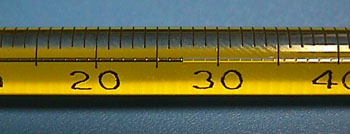
In liquid in most thermometers is mercury, alcohol or a hydrocarbon. Special care must be taken when a mercury thermometer is broken as mercury vapor is toxic.
There are two types of thermometers: total immersion and partial immersion. In order to obtain a correct temperature reading, total immersion thermometers should to be completely immersed in the liquid or gas of interest. Partial immersion thermometers have an inscribed line that indicates the level to which they should be immersed.

A partial immersion thermometer. The line indicates the proper immersion depth.
Thermocouples
Thermocouples allow temperature measurements to be made electronically. When two metals are placed in contact with one another, an electrical potential devlops between them. For some combinations of metals, this potential varies significantly enough with temperature that they can be used to measure temperature.
A thermocouple is made by connecting the ends of two wires made of the chosen metals together and connecting the other two ends to a voltmeter. The connected ends are placed in the substance whose temperature is to measured and the voltage read. Once calibrated, the measured voltage can be used to determine the temperature.
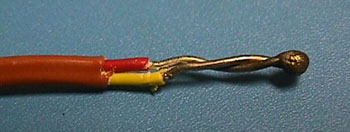
The temperature measuring end of a thermocouple.
The other ends of these wires are connected to a voltmeter.
Thermocouples have two major advantages over traditional thermometers: they can be used over much wider ranges of temperatures and are usually smaller. They do, however, have disadvantages as well. They require a precision voltmeter and the material used to make them are often expensive.